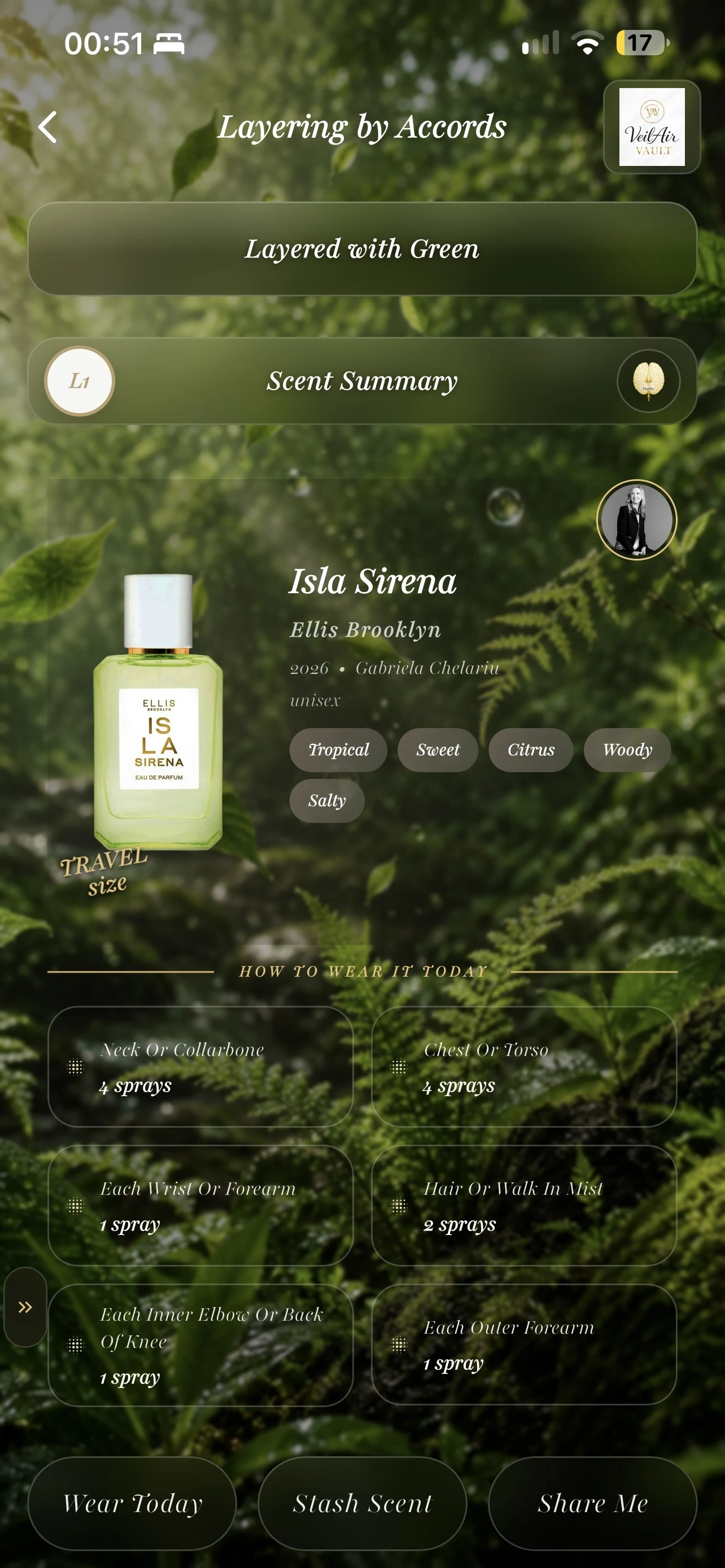
WHAT IS GREEN FRAGRANCE LAYERING?
The scent of life in all its shades.
Green fragrances capture the vitality of the natural world, from freshly cut grass and delicate leaves to crisp herbs, watery stems and the sharp, invigorating character of galbanum. Some feel bright, sparkling and refreshing, while others are bitter, botanical, earthy or unexpectedly sophisticated.
Just as the colour green has countless shades, green fragrances reveal an extraordinary range of personalities. From the freshness of new growth to the richness of deep foliage, Green is an exploration of nature's energy, contrasts and quiet beauty.
VEILAIR SCENT INTELLIGENCE
Thoughtful green combinations shaped by season and personal style.
Discover creative layering possibilities that explore Green in all its shades, from fresh, dewy and understated to aromatic, bitter and expressive.
VeilAir Vault's Scent Intelligence brings seasonal awareness and your chosen spray profile into the experience, helping you explore combinations that reflect your preferences and the way you enjoy wearing fragrance.
GREEN LAYERING · EARTHY LAYERING · WHITE FLORAL LAYERING
Green Fragrances: The Scent of Life in All Its Shades
Discover the freshness, energy and unexpected complexity of green perfumery
If nature had a colour, many of us would imagine green.
It's the colour of new beginnings, fresh leaves, growing gardens and landscapes bursting with life.
And in perfumery, Green can evoke that same feeling of vitality.
Think of freshly cut grass, a leaf crushed between your fingers, the delicate freshness of new shoots or the crisp aroma of a garden after rainfall.
But just as nature contains countless shades of green, green fragrances have an extraordinary range of personalities.
Some are bright, refreshing and almost sparkling.
Others are sharp, bitter, herbal, watery, earthy or deeply vegetal.
There are green fragrances that feel soft and elegant, and others that capture the untamed intensity of dense foliage.
Green isn't always gentle. It isn't always sweet. And it doesn't always smell conventionally fresh.
Green is the scent of life in all its shades — from the first delicate shoots of spring to the deep, untamed richness of nature.
Not All Green Notes Smell Alike
Freshly Cut Grass — Crisp, vibrant and instantly recognisable, evoking the bright, living scent released when grass is cut.
Green Leaves — Fresh, leafy and botanical, ranging from delicate young foliage to darker, more intense impressions.
Crushed Leaves — Sharp, immediate and sometimes slightly bitter, capturing the aroma released when leaves are rubbed or broken.
Green Stems — Crisp, sappy and vegetal, suggesting freshly snapped plant stems.
Galbanum — Intensely green, bitter and resinous, with a sharp botanical character that can feel strikingly elegant or dramatic.
Violet Leaf — Cool, watery and subtly metallic, sometimes reminiscent of cucumber or freshly crushed foliage.
Tomato Leaf — Distinctively green, herbal and slightly pungent, evoking the leaves and stems of a tomato plant rather than the ripe fruit.
Fig Leaf — Green, leafy and sometimes softly milky, with a character that can feel both botanical and Mediterranean.
Blackcurrant Bud — Intensely green, fruity and sometimes sulfurous, with a sharp, distinctive aromatic personality.
Petitgrain — Fresh, leafy and aromatic, often with citrus-peel, woody and gently bitter impressions. It is commonly obtained from the leaves and twigs of the bitter orange tree.
Basil — Bright, herbal and aromatic, sometimes with peppery, sweet or slightly anise-like nuances.
Mint — Cool, refreshing and unmistakably herbal, ranging from sweet and gentle to intensely invigorating.
Green Tea — Delicate, botanical and sometimes softly bitter, evoking a lighter, more understated form of green freshness.
Matcha — Green, powdery and tea-like, sometimes with vegetal, creamy or gently bitter impressions.
Green Bell Pepper — Crisp, vegetal and distinctive, with a sharper, more savoury character than many familiar green notes.
Green Apple — Crisp, tart and juicy, representing the brighter, fruitier side of green fragrance impressions.
Green Rhubarb — Tart, sharp and vegetal, with a lively character that can feel refreshing rather than traditionally sweet.
Green Sap — Fresh, resinous and intensely botanical, suggesting the living interior of stems and plants.
Fern Accord — A creative interpretation of lush, green woodland vegetation. The scent of fern in perfumery is generally an imagined accord rather than a single standard fern extract.
These descriptions represent different green scent impressions, including botanical materials, aromatic extracts, individual scent characteristics and imaginative accords. They aren't all separate technical categories, and not every fragrance containing one of these notes will smell predominantly green.
Green Doesn't Always Mean Fresh
One of the most common assumptions about green fragrances is that they must smell light, clean and refreshing.
Many do.
Fresh grass, young leaves and certain herbal fragrances can evoke brightness, energy and the feeling of open air.
But green can also be surprisingly intense.
Galbanum, for example, has a distinctive bitter, resinous character that can feel sharp and dramatic rather than soft.
Tomato leaf can smell pungent and vegetal.
Blackcurrant bud may have an unusual sulfurous quality.
And some leafy impressions can feel dark, damp or almost earthy.
These characteristics are part of what makes green perfumery so interesting.
Green can be sparkling and refreshing, but it can also be bitter, bold and beautifully unconventional.
From Delicate Leaves to Deep Green Foliage
Imagine the difference between a tiny new leaf and the dense foliage of a mature garden.
Both are green, yet they evoke completely different sensations.
A young-leaf impression might feel tender, fresh and almost translucent.
Freshly cut grass can feel vibrant and energetic.
A crushed stem may be sharper, greener and more immediate.
Meanwhile, darker foliage can suggest a richer, more atmospheric botanical character.
This variation allows green fragrances to move between delicate elegance and powerful natural intensity.
Some evoke the freshness of new growth.
Others suggest the abundance of a flourishing garden or the stillness of a shaded woodland.
Green is not one fixed scent.
It's a spectrum of botanical experiences.
The Unexpected Beauty of Bitter Green Fragrances
Not all beautiful fragrances need to smell sweet.
In fact, some of the most distinctive green fragrances celebrate bitterness.
Galbanum is particularly associated with this character.
Its sharp, resinous greenness has an unmistakable presence in perfumery and is closely connected with the history of classic green fragrances.
Other botanical impressions may feel herbal, tart, pungent or slightly astringent.
These characteristics can give a fragrance an elegant, distinctive personality.
For someone who associates green exclusively with gentle freshness, bitter green fragrances can be a fascinating discovery.
They reveal a more assertive side of nature.
One that feels crisp, confident and sometimes wonderfully unexpected.
When Green Feels Watery, Metallic or Sparkling
Another surprising aspect of green perfumery is how differently freshness can be expressed.
Some green fragrances feel dewy and watery, evoking cool leaves covered in morning moisture.
Violet leaf, for example, can have a watery, cucumber-like quality with a subtle metallic edge.
Other green impressions feel lively, tart or almost sparkling.
That sparkling sensation is a fragrance perception rather than literal carbonation.
And not every green scent feels damp.
Some are dry, herbal or sharply vegetal.
This variety helps explain why Green can overlap with other fragrance descriptions without becoming identical to them.
A fragrance can feel green and watery, green and metallic, or green and aromatic.
Each expresses a different personality.
Green, Earthy and Aromatic: What's the Difference?
Green fragrances often share characteristics with Earthy and Aromatic scents, but these descriptions aren't interchangeable.
Green generally evokes living vegetation, including leaves, grass, stems, sap and fresh botanical growth.
Earthy is more closely associated with soil, roots, moss, damp ground and the organic character of natural landscapes.
Aromatic often describes fragrant herbs and other strongly scented botanical materials, which may feel fresh, dry, camphoraceous or richly herbal.
These categories can overlap.
Basil can feel both green and aromatic.
Vetiver may have earthy, woody and sometimes green characteristics.
A forest-inspired fragrance might evoke foliage, damp ground and aromatic plants at the same time.
But Green has its own recognisable identity.
It's often the impression of vegetation itself — the leaves, stems and growing parts of the natural world.
Green Has a Place in Perfumery History
Green fragrances aren't simply a modern interpretation of nature.
They have an important place in perfume history.
Classic green fragrances helped establish a distinctive style that celebrated sharp botanical freshness, bitter resins and elegant leafy impressions.
Balmain's Vent Vert, introduced in 1947, is particularly associated with the expressive use of galbanum.
Chanel N°19 is another celebrated example of green perfumery, demonstrating how a green character can feel sophisticated and composed rather than casual or purely outdoorsy.
Today, green fragrance ideas extend well beyond traditional styles.
Contemporary perfumes explore everything from realistic tomato leaves and fig foliage to tea-inspired scents, herbal gardens and abstract botanical impressions.
The language may evolve, but the fascination remains the same.
Green captures something vivid and recognisable about the living world.
Green Can Be Soft, Sophisticated or Unexpectedly Sensual
It's easy to associate green fragrances with daytime freshness and outdoor energy.
But Green can also feel quietly elegant.
A soft leafy impression may evoke the delicacy of a flower stem.
A watery green fragrance can feel cool and understated.
A deeper, more resinous green scent may feel sophisticated and mysterious.
And a rich botanical interpretation can be atmospheric without becoming earthy or smoky.
This means green fragrances can express far more than brightness alone.
They can feel calm, polished, intriguing or intensely alive.
Sometimes the most memorable green fragrance isn't the freshest one.
It's the one that reveals a side of nature you hadn't expected to encounter in a perfume.
Can Green Fragrances Be Worn Throughout the Year?
Absolutely.
Green fragrances are naturally associated with spring and summer, but their many interpretations make them relevant throughout the year.
Spring: Fresh grass, young leaves, delicate stems and dewy botanical impressions can evoke new beginnings and the return of growth.
Summer: Bright herbal, watery and sparkling green fragrances can feel refreshing and energising.
Autumn: Bitter galbanum, deeper foliage and more textured botanical impressions can feel sophisticated and atmospheric.
Winter: Crisp, resinous or elegant green fragrances can offer a distinctive sense of freshness during colder months.
These are suggestions rather than restrictions.
A rich green fragrance can feel beautiful during summer, while a delicate leafy scent may offer a refreshing contrast in winter.
The complete fragrance, occasion and your personal preferences matter more than a fixed seasonal classification.
Discover Green Beyond the Bottle
At VeilAir Vault, fragrance layering is about discovering new possibilities within the fragrances you already own.
Our Layering by Accords collection explores green fragrances in their many expressions, from freshly cut grass and delicate leaves to bitter galbanum, aromatic herbs, watery foliage and more unusual botanical impressions.
Scent Intelligence helps you discover creative fragrance combinations, with seasonal awareness and your chosen spray profile supporting a more personalised wearing experience.
Through the Fragrance Notes Library, you can explore green notes, understand their different scent characteristics and discover which fragrances in your collection list or feature them.
Whether you're drawn to the freshness of new growth, the brightness of a herb garden or the bold character of bitter green fragrances, there's an extraordinary variety waiting to be explored.
Because Green isn't simply a colour, or even a single scent.
It's the fragrance of life itself — vibrant, unpredictable and beautiful in every shade.